



Comics and animation engage, entertain and delight fans of all ages. And as one SwRI scientist is proving, these fun and creative books, shows, movies and video games can also help people understand complex science, technology, engineering and math (STEM) topics. He uses science fiction in superhero comics and Japanese anime to highlight real-life scientific principles like Newton’s laws of motion, gravity, thermodynamics and more, meeting students, audiences and fans at the intersection of imagination and science.
Listen now as SwRI Astrophysicist Dr. Roman Gomez discusses his popular physics course based on the impossible feats of superheroes, presenting science topics at anime conventions and why this unconventional method is the key to expanding interest in STEM.
Visit SwRI scientist uses anime for STEM outreach to read more about Gomez and his research paper titled, The power of anime: using anime for education and outreach in STEM.
Transcript
Below is a transcript of the episode, modified for clarity.
Lisa Peña: We start the new year examining the impossible feats of superheroes and other characters and what their imaginary powers tell us about real life science. Our guest today uses superheroes, comics, and anime storylines to spark conversations about physics and other STEM topics. We're discussing the intersection of imagination and science next, on this first Technology Today episode of 2026.
[MUSIC PLAYING]
We live with technology, science, engineering, and the results of innovative research every day. Now, let's understand it better. You're listening to the Technology Today Podcast presented by Southwest Research Institute. From deep sea to deep space, we develop solutions to benefit humankind. Transcript and photos for this episode and all episodes are available at podcast.swri.org. Share the podcast and hit that subscribe button on your favorite podcast platform.
Hello and welcome to Technology Today. I'm Lisa Peña. We are launching 2026 with a discussion on science principles in pop culture. Our guest today says superheroes and anime plots stir imagination and curiosity while tapping into complex science, technology, engineering and math, or STEM concepts. SwRI Astrophysicist Dr. Roman Gomez presents at anime conventions, teaches a college course on the topic, and recently was the lead author of a research article published in the Frontiers in Education journal titled "The Power of Anime: Using Anime for Education and Outreach in STEM." He joins us now to tell us about this fun and effective approach to teaching physics, and much more. Thank you for joining us, Ramon.
Image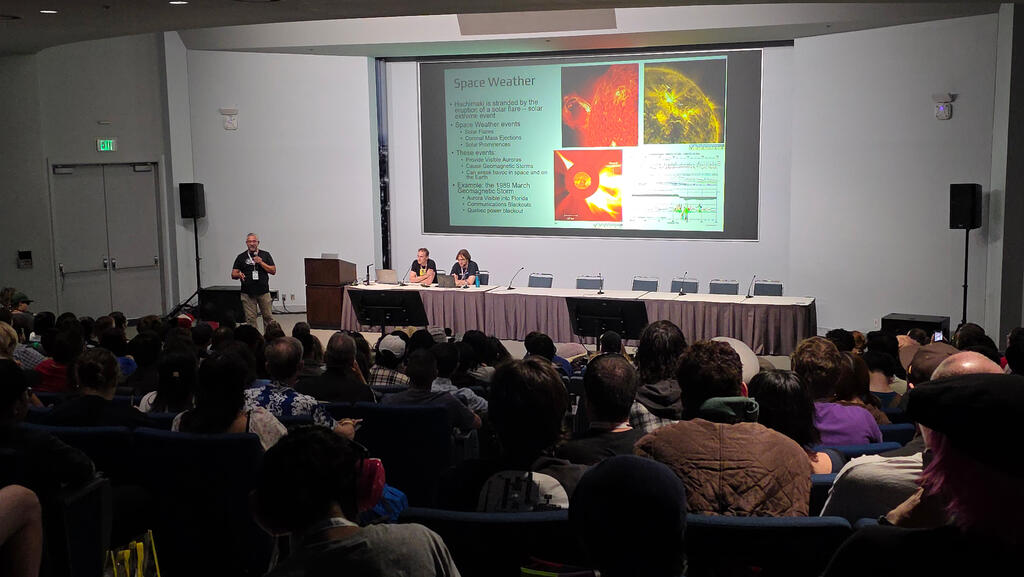
SwRI Astrophysicist Dr. Roman Gomez, pictured during a presentation at Anime Expo in Los Angeles, works on hardware and instruments deployed on space missions and analyzes mission data. He uses examples in comics and anime to explain science and technology topics. Anime Expo celebrates Japanese pop culture in North America.
Roman Gomez: Thank you, Lisa. I'm absolutely elated to be here.
LP: Well, we are certainly excited to have you. This is such a fun topic to start the year with. And we want to get to your college course and of course, your convention appearances, all that in a moment. But let's start with what it is that you do here at SwRI as an astrophysicist.
RG: So I'm mostly experimentalist, which means that I work with a lot of hardware. And I started here in '07, working under Dave Young as a graduate student. And after completing my PhD under Dave, I ended up working on the MMS project, and that basically made me work on ion optics for those instruments. So there were four instruments. They were deployed in 2015. They are still in orbit and I'm still writing papers based on them.
Now, because of that, I also was involved on the latest solar wind plasma sensor that we've launched in September. Also, I work on the Tracers Mission, the analyzers of cusp ion. So again, very heavily involved in hardware. But then I also get to and I'm involved in the data analysis afterwards. So I think the nice thing about it is I get to play in every facet of that particular process, and I really enjoy it.
LP: All right. So you are involved in these space missions. I'm sure there's a lot of highlights that come out of your day to day work. So if you can narrow it down, tell us about your most memorable projects at SwRI.
RG: MMS was the one. MMS stands for the Magnetospheric Multiscale Mission. That was my first launch. That was my first time working with that type of hardware. And again, it's been such a prolonged presence in my life. It's funny to work on a mission that, again, now is actually now more than 10 years old and the instrumentation is still working. But I think there's a sentimental idea behind it because again, that was the first time I ever saw work something that I worked on, launched from the cape. And I'm still to this day, that lump in my throat whenever I talk about it is it's significant.
LP: All right. So that was obviously a huge moment for you watching that launch for the first time. So what is that like? What are your memories of that day?
RG: I remember being there with my daughter. And I remember watching that event occur, and we were four miles distant or so. And, I mean, you can still feel the rumble of the engines. It's a night launch. And being able to share that with my daughter, not only my daughter, but people who were also educators at from Rice, some of my professors from Rice were there in attendance as well, and being able to share that with them was just a very amazing moment.
And my daughter jokingly, like, is standing behind me going, Dad, are you going to cry? Are you going to cry? I'm like, no, miia [my daughter], I'm not going to cry.
LP: But you were going to cry.
RG: Oh man. I tell you what, that was a tough one. That was a tough one.
LP: All right. Certainly a special moment. Let's get into how you share your work, which is why we're here today. You teach a college course, The Physics of Superheroes. So tell us more about this course.
RG: So it started off as a whim. I read this book called The Physics of Superheroes, written by James Kakalios, and I teach at St. Mary's University. And St. Mary's had this really kind of sneaky way to teach science to liberal arts majors. So this class, this nature class comes up. And Richard Lombardini, who's a professor there, says, hey, Roman, would you mind teaching this class for us? And I said, what textbook can I use? He says, you can use any textbook you want. I said, can I use The Physics of Superheroes. And he says, yeah, sure, why not?
That was 20, I want to say 2018. And that was when the Marvel Cinematic Universe was starting to reach its apex. So there was a lot of interest in that class. And I would regularly get a full I guess, a full class. And the really nice thing is because the movies were going on, there were a lot of people who wanted to ask clarifying questions, which I think really enhances the education process. Questions are so important when you're trying to learn.
LP: So maybe they'd seen the movies or read the comics and they're like, is this possible?
RG: Exactly.
LP: This impossible feat, is it is there any way it could happen?
RG: It's really possible.
LP: Yeah, OK. So let's talk about superheroes, what they can teach us. How do superheroes highlight physics principles? What are some of your favorite examples?
RG: So what's funny, so Superman, who of course, what we would say in comic parlance is OP, overpowered, right. But if you look at the original incarnation of Superman, 1938, Siegel and Shuster paid attention to the physics. He could not fly. He could leap tall buildings in a single bound. He was more powerful than a locomotive, but flight wasn't in there. And so that's actually one of the things that goes on with this first chapter of The Physics of Superheroes, because Superman can't fly, but he can jump really high, you're able to talk about Newton's laws of motion, the first, second, and third law of motion.
And in doing so, you understand that Superman has to be stronger than the normal human being in order to leap this tall building which takes you to chapter 2, where we start talking about gravity. And gravity, well, Superman's original, the justification behind Superman's strength was that Krypton was a high density planet. So yes, Superman has this regular stature of a human being, 6' foot 2", which I missed, I wish I had that height, unfortunately. But ignoring some of those deus ex machina things, you could say, well, Superman's stronger because he came from a planet that had a higher gravity. And so then it just follows suit.
And there are a number of different opportunities. I mean, you can use The Flash to talk about special relativity. You can use Storm, who is a member of the X-Men, to talk about thermodynamics. So all of these opportunities to again, as you put, intersect imagination and science, they abound.
LP: All right. And so you just named some great examples there. Are those the examples that really resonated with students or were there others that stood out for you?
RG: Yeah, again, Superman is one. I've used I love Daredevil. One of the things Daredevil is blind, but he has this radar sense. So even though he can't see, he can see, he just sees differently than we do. And so one of the questions I'll pose to my students is, OK, how is it that Daredevil can dodge bullets? And it makes sense, if you think about it, from the fact that Radar is traveling at the speed of light, and he gets this information essentially as fast as we can see things.
And what I think is really funny is a lot of students originally will assume that he has sonar, which sonar travels at the speed of sound, and there's no way you're going to dodge a bullet because most bullets travel faster than the speed of sound. And I also point out, I said, wouldn't it be kind of strange if Daredevil was running around squeaking everywhere like a bat and you're like, oh, yeah, that wouldn't be very intimidating. I said, do you see what I mean? So you have to pay attention. And I think the comics give you a very nice way of visualizing that.
LP: So you're opening the door to these high-level concepts, but because they can see it animated right there in front of them, they can picture it a little bit better instead of just reading words in a textbook.
RG: Exactly.
LP: That's fun. That's really cool. So, along with superheroes, one of your big fun examples that you use often is anime. And you're a regular at anime conventions. Anime has quite a following. So let's start with summarizing anime for people who may not be familiar with it, how do you describe it?
RG: So anime is niche. No, I'm just joking. It's not. It's not niche anymore. And that's the funny thing. Anime now has been on this kind of uphill climb, whereas comics have dwindled. 1978, there was a show called Battle of the Planets, and in Japanese, it's Science Ninja Team Gatchaman. That was published in or produced in 1972. But I remember seeing this animation and how utterly different it was from the Looney Tunes that I was brought up on. And there were very serious storylines, were real stakes.
And so, I remember watching that. And then fast forward to 1984, Robotech was huge. And so to give a synopsis, anime is really when we talk about anime, we're talking about animation that originated in Japan, but it's not of any one particular genre. You've got romance anime. You have action anime. You have supernatural. Believe it or not, there's horror. And there's some pretty scary horror anime out there. So it really is. It's a medium. We're referring to a medium through which storytelling is made. And it really is fascinating. But again, I generally focus mostly on science fiction, because I think there's a lot of STEM concepts that you can garner from that. But yeah, anime is all over the place.
LP: So let's get into that a little bit more. How does anime, particularly the sci-fi anime, showcase the STEM topics that you talk to your students and audiences about? What are some of the best examples?
Image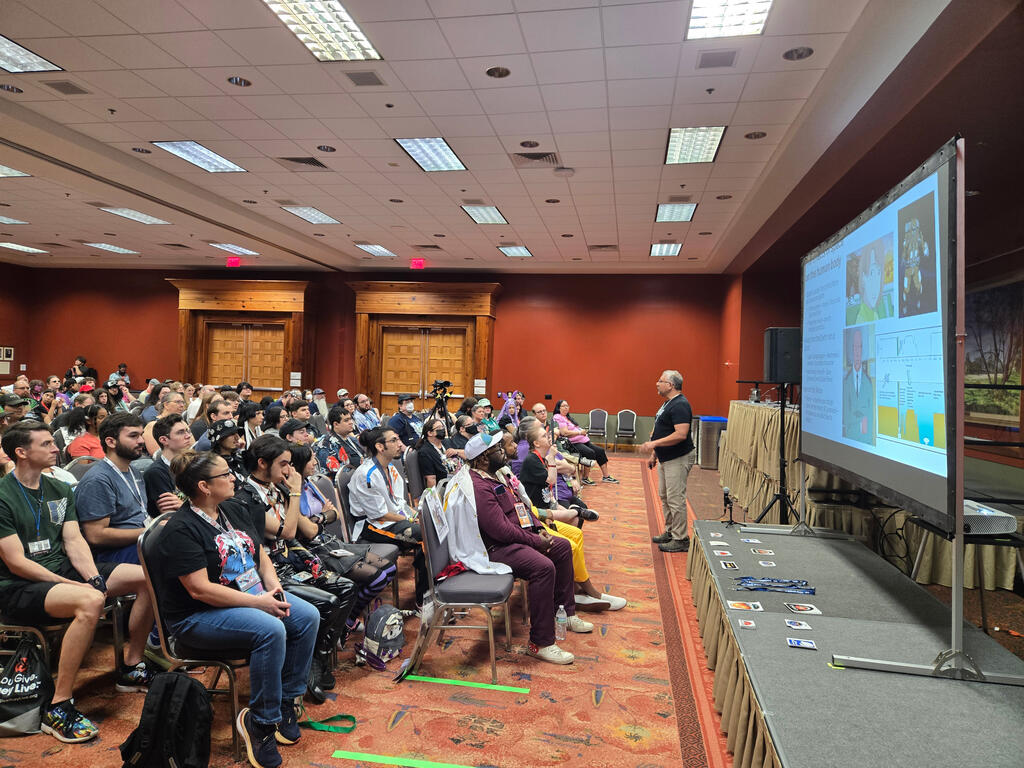
Gomez presents at San Japan in San Antonio, the largest anime and gaming convention in South Texas.
RG: So one of my, oh you would ask that now. So one of my favorites is one called Gunbuster, which is really not a well-known anime, but it is it was the directorial debut of some guy by the name of Hideaki Anno, who also put forth my favorite anime of all time, Neon Genesis Evangelion. But that's another story. We can do another podcast on that one.
But in Gunbuster, there is this super powerful robot that they're trying to use to defeat these aliens from off world. Gunbuster has as a character, this main character, a female protagonist who is piloting this ultra powerful robot which is capable of relativistic speeds. And one of the things I thought that was fascinating is that they properly treat time dilation. I mean, they paid attention to the science of special relativity. If you have an object that's moving at faster or not faster, but an appreciable portion of the speed of light, then the way that people in that vessel experience time is quite different from the way you and I are experiencing it now. They're time dilates. Their clocks tick slower.
And so there were two very accurate treatments, one where the main character sees her father on the ship called Aleutian, which she hadn't seen him for seven years, but only two days had transpired. And then another one where I think there was another situation where there was I want to say, a six-minute delay, but it led to a year or half a year delay on the Earth. So again, that idea that they paid attention to that scientific detail to me is just fascinating.
And another thing, and I don't want to go too far on this because I could talk about it forever. But they also, at the end of each anime episode, each of those episodes, they have a science lesson. And so there was one that talked about special relativity. And then there was another one that brought up the cosmic microwave background, which is this afterglow of the Big Bang. And what was fascinating to me is that they mentioned it. They mentioned that space is an absolute zero. It's got this temperature.
Now, mind you, I watched this anime when I was 20. So I learned about the cosmic microwave background before I even went to graduate school from an anime. So again, just these little tidbits, these little morsels of science goodness in some of these anime, it's magnificent.
LP: And again, just embedding these really high level topics creatively within animation, that is a talent.
RG: Yeah, it really is.
LP: Yeah. OK, so you touched on several examples. Can we dig into one of them? What's one that you can just explain for us right now?
RG: Let's see. So God there's so many that I've done. So I talked about Gunbuster. Gunbuster is one of my favorites. There was another one though, that when I went to Anime Expo this last year, I promised that I was going to talk about space physics. And there's this anime called Planetes. I think it was produced in 2003. And it is heavily focused on space physics, which happens to be one of my essentially the specialty, not only of mine, but that of the division and a number of things it brought to the fore, very germane things, things like space junk, things like a prolonged human presence on space stations. We were already trying to move towards that.
They also address a prolonged human presence on the moon. And not only that, but the effects of living on the moon. If you were born on the moon, the biological processes that drove, that allow us or lead us to develop the way we do here would be different. It's in a different gravitational environment. So you may have people who are 12 years old who are 6 feet tall, and they couldn't come back to the Earth because their bones would be too brittle.
There's another thing that they talked about that I think is very again, important, is this idea of this protective cocoon that we have around our planet called the magnetic field, the magnetosphere. Because we have the Earth has a magnetic field, we aren't subject to a lot of damage from cosmic rays and things like that. And so then they juxtapose that with people who have spent 10, 20 years out in space and they're dying of radiation sickness.
So these are things that we don't think about on a regular basis because we're here on the Earth. But it is something that we have to think about if we are going to become a spacefaring civilization. And I think it's important and really amazing that they included that in their makeup.
LP: All right. Really neat ideas within anime. So you present these ideas, these topics at conventions. What is a convention like?
RG: Ok, It's really funny. The first anime convention I went to is anime, sorry San Japan, it's here in San Antonio. It's great. I highly recommend people go. It's so much fun. But I remember sitting there and thinking, I teach a class. I know that I could do because I sat in on panels, I love panels. So I said, there's a I bet you there's a way that I can adapt what I talk about in the class to this panel.
So I remember it was in 2021, right after COVID. I pitched my Physics of Anime Panel to San Japan and they picked it up. And then I went from there. I did it at San Japan again. Then I did it at Anime Matsuri, which is one of the larger anime conventions here in the state of Texas. And then Anime Frontier, which was up in Dallas. The largest anime convention in the United States is Anime Expo. So in 2023, I said, OK, I played the same game I did when I decided to marry or asked my wife out. You shoot your shot and maybe you lose.
Well, sure enough, I pitched this panel to Anime Expo. Well, unbeknownst to me, they had a panel series that focused on academic concepts. So there's a gentleman by the name of Billy Tringali. He's a wonderful guy, and he is the editor in chief of something called the Journal of Anime and Manga Studies, JAMS, and he was the one who kind of brought that symposium together. That was the first year. Billy saw my panel presentation, my proposal, and picked it up.
So I ended up presenting at Anime Expo that year with two friends of mine from Jet Propulsion Laboratory. The following year, I presented again. And this time, my two friends had a little bit larger presence and Billy had already factored us in. I think we were. We ended up winning an award for the outstanding academic panel presentation. So that was 2024. So 2025, this past year, we went, we were asked to be the concluding panel. And we also said, we're seeing all this really, really interesting, a lot of people with a lot of interest.
We, I think regularly, all three years, running, we turn away about 250 people because of that room can only hold about 300 people. And I'm like, man, I don't even have this many people showing up for my physics lectures. But sure enough, I mean, what we ended up doing is say, let's run a survey. Let's do just a quick survey using QR codes. And I guess people, I would highly recommend if anybody is interested in this, read the paper. But the upshot was that almost by a 2 to 1 ratio, people found science to be more approachable after the panel.
So we did a pre-panel versus a post panel evaluation. And people just seemed really down with the idea that, wow, you can actually put forth some really interesting concepts and do so in a very friendly manner.
So once we did that, once we did that survey, we were like, let's write a paper. And sure enough, it just got published in November, right around Thanksgiving time.
LP: All right. So we will talk more about your paper in a moment. And that's really exciting information to get back in real time that what you're doing is working. So aside from the survey, what are people telling you when they walk up to talk to you? What kind of feedback are you getting?
RG: It's funny. So there are people who are returners, who keep coming back and they'll say, I will never miss your panel as long as you guys are presenting here. Other times, I think one was one of them was a biology professor or one of them was a biology teacher. And they said, what do you recommend if somebody wants to start doing this? I said, well, number one, make sure you watch the anime because people can smell a poser, right off.
But other stuff that I get is there was a guy there, he was 30 years old. And he came up to me and he goes, I told him my story. I told him how I during a discussion session, I told him how I kind of started late. I didn't get my undergraduate degree until I was 32, and I didn't get my PhD until I was 41. And he came up to me and he said, I'm 30 years old and I loved hearing your story because I want to be an engineer. He goes, what's your advice? I said, go be an engineer. Go be an engineer. Go out there. And I said, understand now that you're older, you're more mature.
And it's not the only one. Another thing that was really funny is when I presented this past, this past time in '25, I was wearing my Southwest Research Shirt because homeboy got to represent that kind of thing. So what was funny is that at after the presentation, a young woman came down and she goes, I never thought I'd see a Southwest Research shirt again. She goes, my dad worked there and my dad, I think he worked in fire science or something like that. And she goes, you don't understand how great it is to see that emblem.
Yeah, so I mean, overall, I mean, I've never heard anyone say you're a charlatan, you're doing terrible work or anything like that. People seem genuinely engaged with it. And, again, the whole idea is to not only educate but entertain, because I've been in some physics lectures, I've been in some talks, and I'm like, man, I would this is killing me. So engagement, it's about meeting people where they are. I always call it evangelism, right, meeting people where they are, meeting people in their interest and finding a way to open those lines of conversation. I think that's exactly what this whole physics of anime thing does.
LP: All right. You are really connecting, and in some cases, helping people find what's next or their next career move. So, I mean, it sounds like you're doing great work out there. And through these convention appearances and your classes, you found that this is really an effective approach to teaching STEM topics as we've discussed. So you were the lead author on the paper you just mentioned. You were the lead author. It's a research article published in the Frontiers in Education Journal titled "The Power of Anime: Using Anime for Education and Outreach in STEM." So you mentioned your survey. So tell us more about your observations and the research that resulted in the paper.
Image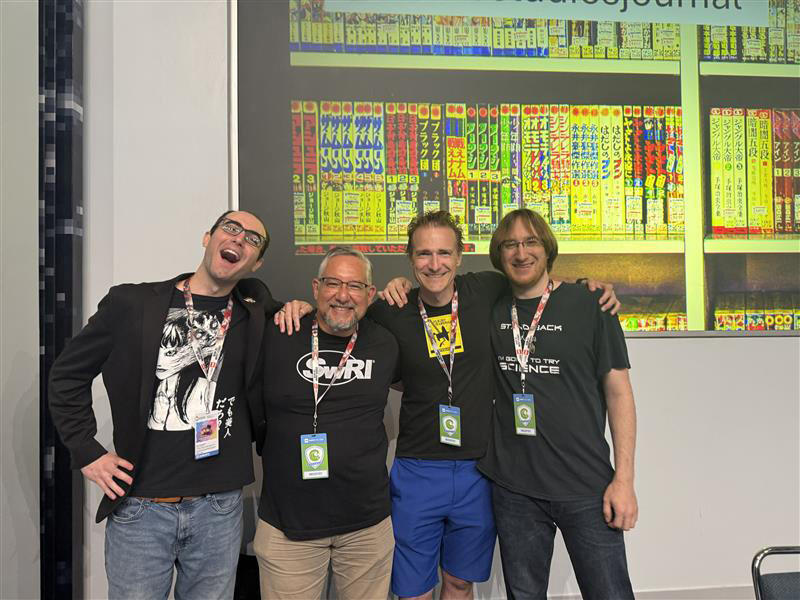
Gomez is lead author of the paper titled, The power of anime: using anime for education and outreach in STEM, published in the Frontiers in Education Journal in November 2025. He is pictured here with the co-authors of the paper.
RG: Yeah, again, I think seeing the interest one of the things we wanted to know was how many return people we had and how many new. And what was really surprising to all of us was that 85% of the people who came to that particular panel were first time visitors. There were 15% were return customers, so to speak. But there was this the idea that there was this interest means that you're hitting the right, you're hitting on the right cylinder, right. You're hitting on the right rhythm. People want to be informed, but you're doing so in a way that is very friendly.
The other thing was, I'm trying to think, there were some really fascinating stuff. Well, another thing that was very important is the demographic that we're hitting. So we're hitting the 18 to 24 and the 25 to 35 or 25 to 36. And the interesting thing about those demographics, one, 18 to 24, those are young people. They're going to be new voters. They're going to be new students. There are people who are thirsty for knowledge. They really are.
And then the next group up, I don't know if they're so new to it, but these are also people who may be kind of like I was a second chance, second chance college student, someone who's looking at going to graduate school and maybe just maybe well, why would I think of engineering? Why would I think of science? It sounds so boring. It sounds so taxing, because I think I've made the joke that anime is a beautiful thing. It's uplifting. Physics can be soul crushing. And what kind of person would take two things that were so diametrically opposed and bring them together.
And I said, well. hello, my name is Roman and I have issues, but the bottom line is, again, it's finding a way to make things appealing to people and to let them know that there are options out there. I can honestly tell you there's probably a direct line between my watching anime, my reading comics, and my becoming a STEM major and ultimately a physicist, an astrophysicist, because that is, I think you need to have an imagination to be in that field.
LP: And it's that realization that your this interests me and I want to know more. There's that curiosity. So let's talk more about that. Why is it important to make STEM topics relatable, approachable? What is the goal with that?
RG: I think there's a number of things. Seeing more people, not just interested in STEM, but also cognizant of those concepts. I mean, you can see it all over the place, that we live in, the information age, where quite literally all the information of the world is at your fingertips. But the ability to sort through that information, critically think, almost seems to be at an all time low. And so what's the idea behind this?
Feed that knowledge. Feed that curiosity. Because obviously if you're searching up general relativity on the internet, you're interested in it. So how can I make this more approachable? Because let's face it, something like general relativity is very mathematically intensive. And you're not just going to jump in there right away unless you're some kind of genius, which I'm definitely not. But if you take this kind of iterative step, going from entertainment, and then eventually get to the soul crushing part of it, it might be a better way to go about moving through that sequence.
One of the things I end up with, because I teach in astronomy class too, is I always jokingly tell my students at the beginning of the semester that my job is to make them feel as insignificant as possible, and if they still feel significant by the end of the semester, let me know so I can put them in contact with a good counselor. I'm being completely facetious about that. And when I'm end off the last chapter we talk about is the possibility of finding life elsewhere, not just the solar system, but the universe.
LP: And you do feel small after that kind of a talk.
RG: You do. But in the same token, but you can ponder this. We are able to ponder our existence. Are we alone and what are the implications if we aren't? But, but you have to have a jumping off point because you can't just go from A to B. That sounds crazy, but you've got to work your way up. And it's kind of like with weightlifting, you don't just walk into the gym and squat 300 pounds, you've got to actually work your way up to it. And so I find that this engagement using anime, using STEM, and engaging people where they are, is a really nice way to go about it.
LP: So I do want to talk more about your background. The way that you got to where you are now. So what was your path to astrophysics? And you mentioned a little bit of your inspiration, but tell us more about how you got here.
RG: So at my Tom talk, I talked about the first time I saw the Aurora borealis.
LP: Now a Tom talk is like our Ted Talk talks here at Southwest Research Institute.
RG: That's right.
LP: So you gave a really interesting talk. Yes, I want to dig more into that. Go ahead.
RG: No, no. The first thing I did when I got out of high school was join the army and joined the army infantry because I felt like, OK, I need to serve. And I don't know how any other way to do so. And I went through the army. I was served during the first Gulf War.
And then when I got out of the army, I tried to do everything I could to make a living without going to college. Because I heard all my life that you don't need a college education, you don't need a college education. And so what ends up happening is you say, I don't need a college education. So you're going to hit home.
When I decided to go to college, it was throw my hands up in frustration. Fine, I'll go. But then I said, well, doctor sounds good, medical doctor. And I was thinking about this the other day because I'm getting ready to teach electricity and magnetism.
So when you go to the medical field, you have to take physics. So you can either take college physics or university physics. And I took university physics. And that answered that age old question, when am I going to use all this math that I've been learning, because I've been learning a lot of calculus. It's like, when do I use it? And when I started learning electricity and magnetism, I fell in love. And I remember that year, it was 2000. My father passed on March 5th of that year. My daughter, Rudy, was born later that year.
And I started asking myself, why what do I really want to do with my life, because I knew medicine just wasn't there. And so I jokingly say, I saw the light, turned to the dark side, became a physicist, and I never looked back. And it's been the most fulfilling thing. And now that was Southwest Texas State in 2000. I got my bachelor's degree in 2002, and then I started at Rice in 2003, and I finished my PhD while working here as a full time employee, so much love to the Institute. The Institute has taken very good care of me. And, I'm eternally grateful.
But I also am very eternally grateful that the Institute has allowed me to go out into the community and talk about not just the work I do, but do so in a way that's kind of individual to me, that's something that's unique to me.
LP: What I find interesting about your story is you were that person saying, I don't need college, but then you've gone to the top getting your PhD. We call you Dr. Gomez now.
RG: I made my mom call me that one time.
LP: I'm sure she was happy to oblige, very proud of you. I'm sure. OK, so what is your advice for someone else who is thinking about pursuing the big, scary field of science or physics or any STEM field, really?
RG: I think, ask questions. That is the most important thing you can do. How do you know if something is right for you? You ask questions and you test it, just like an experimentalist would. If I have a question, I can go port all kinds of theories. But until I make some kind of measurement, until I try to find out some result, it's going to be kind of inconclusive. And that's another thing that I always try to do. I actually carry business cards with me when I go to these anime conventions, because people will take them from me and they'll bounce questions off of me. What do you think about this field? What do you think about that field? I'm thinking about doing chemistry. I'm thinking about doing biology.
And in that case, even if you can't answer the question, I know people who are biologists. I know people who are chemists, and I can point them in that direction. It's all about, again, meeting people where they are and being able to provide an answer when people desire to hear it.
LP: All right. So if any listeners out there want to hear more about your connections between superheroes, comics, anime and the sciences, do you have any upcoming convention appearances planned?
RG: Oh, absolutely.
LP: If so, we need some details.
RG: So I know. So I'm going to Anime Expo again. Anime so my co-author Billy Tringali, who's also the head of the JAMS, JAMS board, invited me to be on the JAMS board this year. So not only am I going to present my physics of anime at Anime Expo in '26, but I'm going to be there in more of I guess, official capacity, which means I get to walk around with an industry badge and go wherever I want.
LP: You've made it.
RG: Yeah, it's so much fun. I'm definitely going to San Japan. I always go to San Japan because you've got to celebrate where you started, and San Japan is where I started. It is a wonderful convention. It's grown. I think when I first went there, I think they had 17,000 people. And this past year they had 32,000. So as they say, there's big, big con problems now. But that's really great. And my wife actually went. I went with my wife and my friend, Dr. Justyna Sokol, also co-presented with me during that Physics of Anime panel. We had an absolute blast.
I am trying to see if I can get one done in Pittsburgh. I have a friend of mine from West Virginia University, Dr. Catherine Goodrich, and we have been talking about collaborating for quite some time. And so there's an anime convention called Tekko there. T-E-K-K-O. And I am going to submit a proposal to them, I think, in the next month or so. And then there's one called, I want to say it's Dream Con that's supposed to take place in Houston. So yeah, I'm just like this huge Con Weeb now, go figure.
LP: You'll be at all of them then.
RG: I'm doing my best. I'm doing my best.
LP: Where's Anime Expo.
RG: Anime Expo is in LA. It's in Los Angeles County. And I mean, last year they had, over a four day period, about 410,000 people.
LP: That's a huge audience.
RG: It is ridiculously huge. Yeah.
LP: And generally, what month is that one?
RG: It's always July the 4th weekend.
LP: All right. So Anime Expo in July in LA. San Japan, right here in San Antonio.
RG: That's Labor Day weekend.
LP: Labor Day weekend, OK. And then stay tuned for more information on Tekko in Pittsburgh and Dream Con.
RG: Yeah, Dream Con is in Houston.
LP: In Houston. So those are TBD.
RG: TBD.
LP: They're on your radar. All right. Looks like there's plenty of opportunity. Someone just searches up your name. They'll be able to find you, figure out where to get in on one of your exciting panels. Well, Roman, thank you so much for sharing your expertise and this unique, relatable approach to teaching complex STEM topics.
RG: Thank you for having me.
And thank you to our listeners for learning along with us today. You can hear all of our Technology Today episodes, and see photos, and complete transcripts at podcast.swri.org. Remember to share our podcast and subscribe on your favorite podcast platform.
Want to see what else we're up to? Connect with Southwest Research Institute on Facebook, Instagram, X, LinkedIn, and YouTube. Check out the Technology Today Magazine at technologytoday.swri.org. And now is a great time to become an SwRI problem solver. Visit our career page at SwRI.jobs.
Ian McKinney and Bryan Ortiz are the podcast audio engineers and editors. I am producer and host, Lisa Peña.
Thanks for listening.
[MUSIC PLAYING]
A new paper by Southwest Research Institute staff details how using popular culture could effectively teach science, technology, engineering, and mathematics (STEM) concepts. The paper shares insights from SwRI staff who hosted “Physics of Anime” panels at anime and hobbyist conventions across the country, presenting complex scientific ideas in an engaging way to curious attendees.
How to Listen
Listen on Apple Podcasts, or via the SoundCloud media player above.